
Portrait of Daniel Choi

Hi! I am Donghyun (Daniel) Choi, PhD Candidate in Operations Management at Georgia Institute of Technology, advised by André Calmon and Beril Toktay.

My research investigates the operational implications of sustainability targets and provides managerial and policy insights using analytical modeling and empirical methods. Specifically, I am studying this in the context of packaging material recycling, corporate carbon targets, and energy system decarbonization. I was nominated as a Novelis Graduate Scholar and am closely working with companies in the Drawdown Georgia Business Compact. I am on the 2026–2027 academic job market.

Research

Working Papers

Slack and Science-Based Target Commitments

Donghyun Choi, Abhinav Shubham, and Manpreet Hora

Presented at: ARCS (2026, Singapore); POMS (2025, Atlanta; 2024, Minneapolis); MSOM (2024, Minneapolis).

Under Review
AbstractPublic article ↗

The Science-Based Targets initiative (SBTi) has become the leading framework for externally validated corporate decarbonization targets, yet commitment varies markedly even among firms facing comparable stakeholder pressures. We examine how a firm's internal resource position shapes its likelihood of committing to the SBTi, distinguishing between unabsorbed slack (e.g., liquid, readily redeployable resources) and absorbed slack (e.g., resources embedded in operating routines and administrative structures). Using a discrete-time hazard model estimated by probit on a global panel of 13,465 firms from 2014 to 2021, we find that the two forms of slack have opposing associations with commitment. Unabsorbed slack is negatively associated with commitment, consistent with liquid resources enabling managers to postpone an uncertain undertaking, whereas absorbed slack is positively associated with commitment, consistent with embedded resources supplying the coordination capacity that target setting requires. The negative relationship between unabsorbed slack and commitment is stronger when Scope 3 emissions constitute a larger share of total emissions and weaker among firms with prior experience of reducing supply-chain emissions. The positive relationship between absorbed slack and commitment is stronger among firms with internal carbon pricing or climate-linked incentives. Our findings indicate that financial liquidity alone does not translate into credible climate undertakings such as committing to the SBTi. Firms should pair embedded organizational capacity with governance practices that direct it toward their climate objectives.
Closing the Loop or Opening the Market? Implications of Recycled Content Mandate and Allocation Policy

Donghyun Choi, André Calmon, and L. Beril Toktay

Presented at: MSOM (2026, Boston); POMS (2026, Reno); INFORMS (2025, Atlanta; 2024, Seattle); Novelis Scholars Day (2025, Novelis Global Research and Technology Center).

Work-in-progress

Publications

  1. Choi, D., and Kim, Y. J. (2023). “Local and global experience curves for lumpy and granular energy technologies.” Energy Policy, 174, 113426.

    AbstractPaper ↗

    Current electricity generation systems have been dominated by lumpy energy technologies because the electricity they create has been cheaper than that generated from granular technologies. Accelerating the development and deployment of low-carbon technologies to mitigate climate change will require a better understanding of how lumpy and granular technology innovations work to reduce domestic and foreign technology costs. We estimated one-factor and two-factor experience curves to identify drivers and assess the relative importance of local and global learning experiences in Korea's climate change mitigation efforts between lumpy and granular energy technologies. The results suggest that granular technologies are likely to play a key role in mitigating climate change due to a rapid decline in its cost. Further tapping the local potential of cost reduction in granular technologies will require decreasing the soft costs of solar technologies and ramping up wind power plant installations. The results also suggest that knowledge spillover is relatively limited and slow for lumpy technologies, but frequent and fast for granular technologies. To maximize the spillover of global learning to local innovators, policy makers should improve the absorptive capacity of a country and strengthen the global network ties of local firms.

  2. Choi, D., Eom, J., and Cho, C. H. (2023). “Integrating Market and Technology Uncertainties into Levelized Costs of Power Generation Technologies: A Case of Korea.” Energy Strategy Reviews, 45, 101046.

    AbstractPaper ↗

    Like many countries responding to climate change, Korea also faces an unprecedented transformation of its power sector into a low-carbon system. To evaluate the most advantageous combination of technologies and necessary policies for achieving the goals of such a transformation, this study decomposes the historical development of the total cost of five major power technologies in Korea into three cost components and identifies the underlying driving forces and variabilities of each. We then project the likely distribution of costs in 2030 using Monte-Carlo simulation and simulate the possible impact of climate and environmental policies on the economic landscape of competing technologies. Our results show that the business-as-usual dynamics of key techno-economic-market factors are not likely to secure the economic viability of the proposed energy transition in Korea. Introducing carbon prices or strict environmental policy is imperative in Korea to make renewables and less carbon-intensive gas power remain cost-competitive with coal power.

  3. Choi, D., Ahn, Y. H., and Choi, D. G. (2020). “Multi-Criteria Decision Analysis of Electricity Sector Transition Policy in Korea.” Energy Strategy Reviews, 29, 100485.

    AbstractPaper ↗

    The electricity sector in Korea is facing complex sustainability issues with recent government energy policy reprioritizing social and environmental concerns over economics. As a response, we developed a multi-criteria decision making (MCDM) model linked to an energy-system model to assess the sustainability of different policy scenarios in the Korean electricity sector. Our analysis shows that, while the new transition policy is not an attractive option in total cost and emissions, it can be desirable when we consider other aspects. Based on several trade-off analyses among different criteria, the most preferred direction of energy transition is reducing coal. This study, based on realistic policy scenarios, will assist in resolving the sustainability conundrum of the Korean energy sector.

  4. Kim, J. T., Cho, C. H., and Choi, D. (2019). “A CGE Analysis of Peak Load Pricing using Electricity Sector Detailed Database.” Korean Energy Economic Review, 18(2), 1–37.

    AbstractPaper ↗

    This study develops a CGE model that disaggregates the electricity sector by load-generation technology pairs using the methodology of GTAP9 Power DB and analyze the impact of peak-load rate increase. The Power DB is updated with Korea electricity market data and used as model input data. Increase in peak-load rate reduces the output of the electricity sector and electricity-intensive manufacturing sectors. Although total electricity consumption is reduced by the rate increase, load shift from peak to base increases the share of coal and nuclear in generation portfolio. Sensitivity analysis on substitution elasticity between loads, a key parameter, shows that more flexible load shift to less cost base-load increases the total electricity consumption and the output in the manufacturing sector. In the meanwhile higher base-load demand utilizes more coal power generation which exacerbates the carbon mitigation effect of peak-load rate increase.

  5. Choi, D., Kasdan, D. O., and Yoon, D. K. (2019). “Analyzing Disaster Loss Trends: A Comparison of Normalization Methodologies in South Korea.” Risk Analysis, 39(4), 859–870.

    AbstractPaper ↗

    Increasing concern for climate change adaptation and disaster risk reduction is driving the need for more accurate and sophisticated tools of analysis to protect populations. Standards of analysis that can normalize measurements under various contexts are particularly valuable in the global arena of disaster management. One concern that may benefit from normalizing is the analysis of disaster loss trends. Previous studies have used a combination of inflation, wealth, and societal factors in their normalization of disaster loss methodologies. This study examines the various normalization methods in previous research and applies a selection of eight formulae to 50 years of disaster data in South Korea. The results show both decreasing and increasing trends in disaster damage losses based on the methods, but there are curious biases under the results that may be artifacts of Korea's unique experiences in economic development. The conclusion discusses how the case of Korea may help to clarify the optimal normalization methodology for other countries.

Teaching

Courses

Georgia Institute of Technology

Operations Management (MGT 3501)
  • Spring 202660 students · Evaluation: 4.77/5
  • Summer 2025 (online)59 students · Evaluation: 4.63/5
  • Spring 202560 students · Evaluation: 4.65/5

Korea Army Academy

  • Business Statistics
  • Management Science
  • Decision Analysis

Recipient of the 2018 Best Teaching Award.

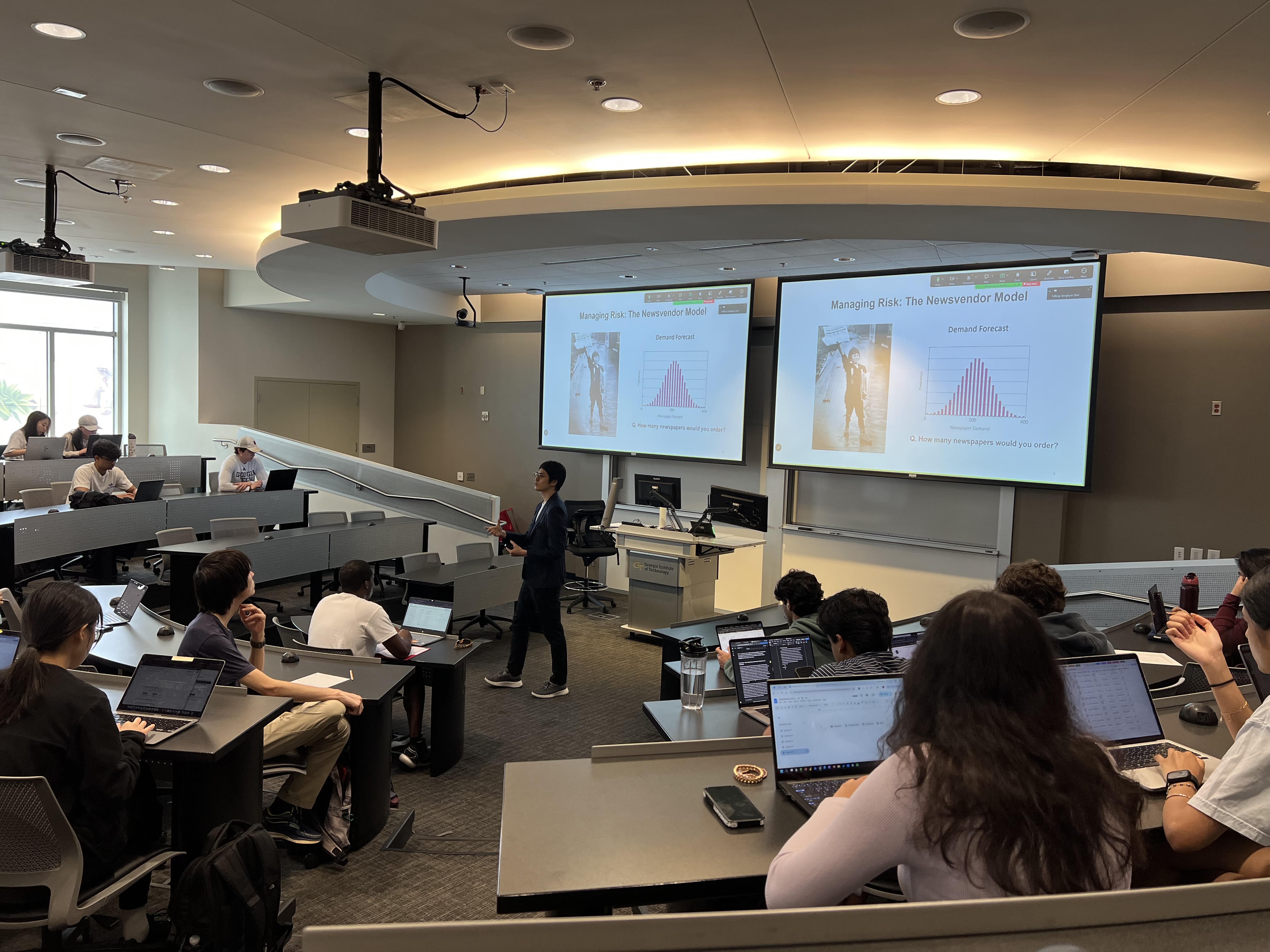
Daniel Choi teaching the Newsvendor model in an Operations Management class

Testimonial from Operations Management Class

1 / 5

“He cared a lot about his students and making sure that they were able to understand what was going on in class.”